
Why I cancelled three SEO subscriptions in one month
I cancelled Ahrefs Lite, a Lighthouse-CI tier, and a Screaming Frog cloud add-on inside a single week last month. Combined cost: $177 a month, gone.
The tools did not get worse. They got replaced by five servers running inside Claude Code, each pulling from the same underlying data sources the paid dashboards sit on top of. Every audit I have run since February has gone through this stack. None of them has touched a paid SEO dashboard.
This post is the actual setup. Names of every server, what each one replaces, what each one costs, and the order I would install them at a new agency in 2026.
What is a Model Context Protocol, in plain words?
The Model Context Protocol is an open spec from Anthropic. It lets a Claude agent talk directly to a data source: your Search Console, your file system, a SERP API, a real browser. Through one standard interface. An MCP server is the small program that exposes one of those data sources. You install it once, and every Claude Code session you open after that can read it.
Think of it as the difference between you opening ten browser tabs to gather data, versus the agent reading ten data feeds at once and writing the audit straight from them. Same data. Different glue.
MCP vs API: what is actually different?
An API is built for developers. It is how software systems talk to each other. MCP is built for AI models. It gives a large language model a safe, structured way to read external systems and use external tools without a developer wrapping every call by hand. Anthropic’s analogy is "USB-C for AI apps": one socket, many tools, no custom cable for each one.
MCP does not replace APIs. It sits on top of them. The DataForSEO MCP still calls the DataForSEO REST API underneath. What changes is that the agent now writes the call, reads the response, and folds the data into its next action without me copy-pasting between a dashboard, a spreadsheet, and a doc.
That is the practical difference. The API is the pipe. MCP is what lets the AI use the pipe on its own.
How does the MCP stack replace paid SEO tools?
Paid SEO tools wrap public data sources (Google’s SERP, Search Console, page-render APIs) in a UI and charge a monthly subscription for access. MCP servers expose those same underlying sources directly to the agent. You skip the UI layer, pay per call instead of per month, and let the agent do the synthesis you used to do by hand.
The savings are real. The bigger win is speed. An audit that took me three hours of clicking now takes about 20 minutes of agent run time. That is the change that makes per-call pricing affordable, because each audit is short.
The five MCP servers in our 2026 SEO stack
1. DataForSEO MCP: keyword volume, SERP data, Map Pack rankings
This one replaces about 70% of what I used to pay Ahrefs for on local clients. The DataForSEO MCP exposes the SERP API, the Keywords-Data API, the Backlinks API, and (the one that matters most for local SEO) the Maps Pack endpoint.
From inside Claude Code I can pull search volume for fifty keywords in one call, scan the live SERP for any city in the Lower Mainland, check the Map Pack ranking on any term, and pull the actual cost-per-click data the paid tools quote. All without leaving the terminal. A full audit on a ten-page client site runs me roughly 30¢ in API calls.
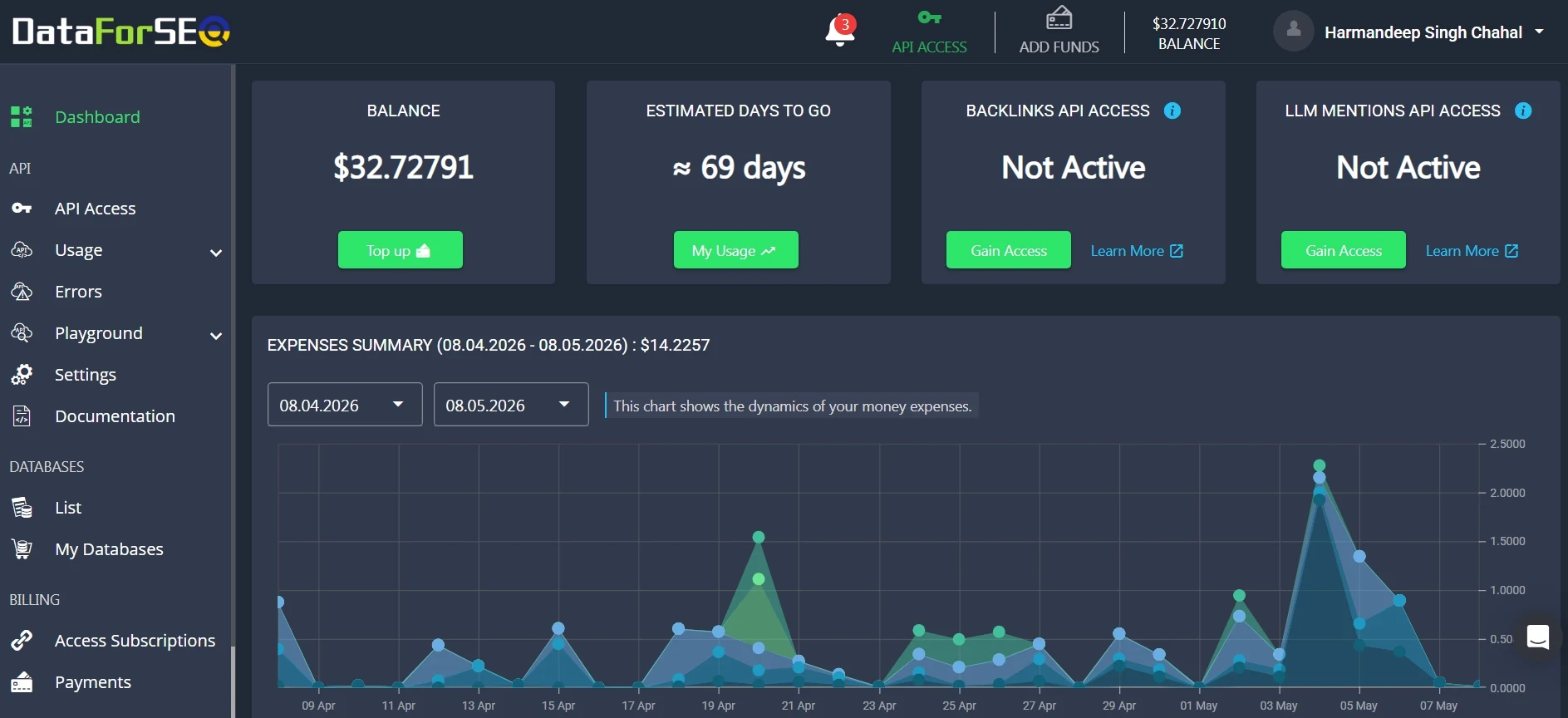
What it is: per-call SERP, keyword, and local-ranking data piped into the agent.
What it replaces: Ahrefs Lite (~$99 a month) for keyword and competitor work on local sites.
2. Firecrawl: site crawls and competitor extraction
I am currently running Firecrawl through its web app and REST API while the MCP install sits on my queue. Same data, slightly more glue code. Firecrawl returns clean Markdown of any URL, plus structured extraction of titles, headings, schema, and internal links.
I point it at five competitor pages and pull every H2, every FAQ block, every schema type into one comparison file. A competitor section-coverage audit that used to take me two hours of manual reading is now twenty minutes of agent work.
What it replaces: a Screaming Frog cloud add-on (~$49 a month) for sites under 50,000 pages.
3. Google Search Console MCP: real GSC data inside the agent
This is the server that changed our morning routine more than any other on this list. The GSC MCP (browse the official MCP server registry for the version you trust) pulls query data, position changes, click-through rates, and indexing reports straight into Claude Code. I run one command, like "show me every keyword on page two and what page is ranking for it", and the agent returns a triaged list with the page URL, the current position, and a suggested fix.
The data is still Google’s data. The MCP just changes how I get to it. The dashboard click-through is gone.
What it replaces: the manual GSC dashboard workflow, plus any third-party "GSC insights" wrapper.
4. Playwright MCP: page render, Core Web Vitals, accessibility
Microsoft maintains the reference Playwright MCP server. It opens a real headless browser, renders any page, and returns Core Web Vitals scores, the accessibility tree, console errors, and DOM snapshots. I use it to confirm that a fix I just shipped actually rendered the way I expected on a slow connection, and to catch accessibility issues before a client launch.
What it replaces: a Lighthouse-CI tier (~$29 a month) for a ten-page client site.
5. Git MCP: Claude Code commits the fix it just found
The Git MCP lets the agent stage changes, commit, and push from inside the same session. Pair this with the file-read tools already built into Claude Code, and the workflow change becomes the real story.
Old loop: audit the site, write a Trello ticket, hand it to a developer, wait two days, ship the fix, retest. New loop: Claude Code finds the issue in the GSC MCP output, reads the file, fixes the markup, runs the Playwright MCP to confirm the render, and commits the fix via the Git MCP. The audit-to-deploy gap on the contractor and dog-daycare sites this quarter went from days to minutes.
What it replaces: most of the manual "audit → ticket → developer queue" loop on small client sites.
Stack at a glance: what each server replaces
| MCP server | What it gives the agent | Paid tool replaced | Old monthly cost | New cost |
|---|---|---|---|---|
| DataForSEO | SERP + keyword + Map Pack data | Ahrefs Lite | ~$99 | per-call (~30¢ per audit) |
| Firecrawl | Markdown crawl + schema extraction | Screaming Frog cloud | ~$49 | per-call |
| Google Search Console | Query, position, indexing data | GSC dashboard + insight wrappers | $0 + time | $0 |
| Playwright | Render, Core Web Vitals, a11y | Lighthouse-CI tier | ~$29 | $0 |
| Git | Commit fixes the agent finds | Manual ticket-and-dev loop | dev hours | $0 |
| Total | — | — | ~$177/mo + dev time | ~$50/mo in credits |
What this stack does not replace
It does not replace the judgment of which keyword to chase. The MCP servers give you data faster. They do not tell you whether kitchen renovation West Vancouver or home renovation North Shore is the higher-margin Map Pack term for a renovation contractor. That call still has to come from someone who understands the local market. The skill in 2026 SEO is asking the right questions, not paying for the right tool.
It also does not replace good schema, good content, or honest case studies. The MCP layer makes the audit faster. The work that wins the Map Pack is well-structured pages, real reviews, and accurate categories on a Google Business Profile. That work still has to happen.
That is the part most people get wrong about AI tooling in SEO. The agent is a faster pair of hands. It is not a replacement for understanding the local market. It is also not a replacement for shipping good pages.
Real proof: three Lower Mainland clients ranking on this exact stack
From our projects
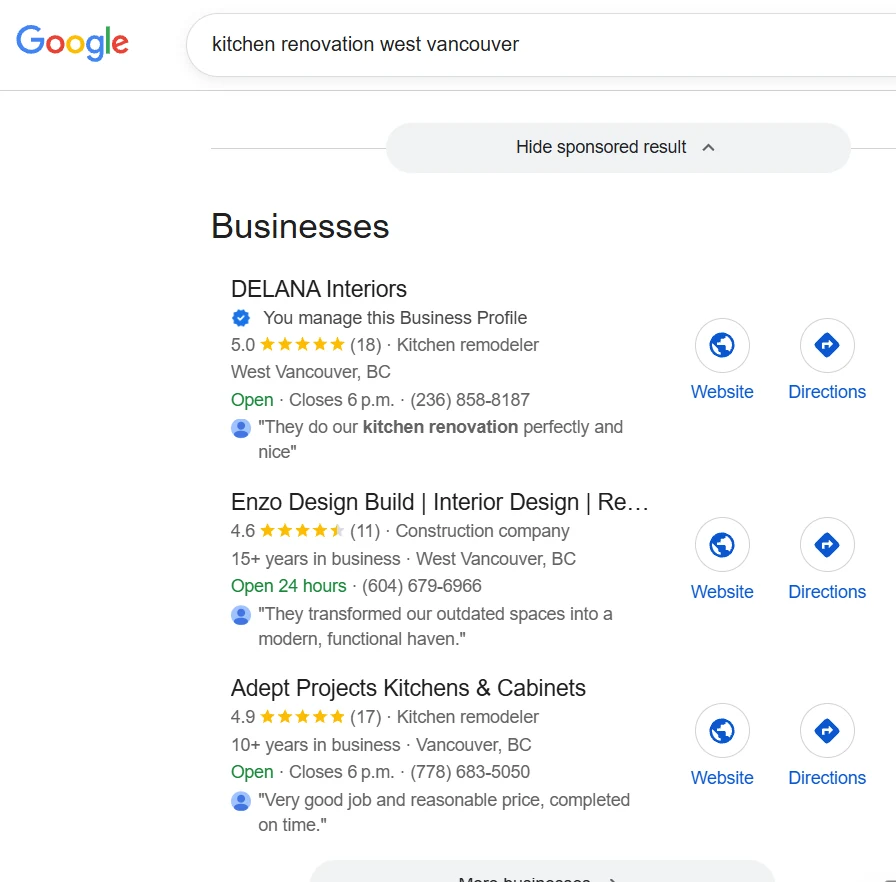
DELANA Interiors, a West Vancouver renovation contractor, sits at #1 in the West Vancouver Map Pack for kitchen renovation with 5.0 stars and 18 reviews, above two competitors with 10 to 15+ years in business. The audit that surfaced the schema and category fixes ran entirely through DataForSEO, GSC, and Firecrawl.
Super Sanitation, an Abbotsford industrial sanitation company. Map Pack visibility jumped after a category and service-area cleanup that came out of a thirty-minute MCP-driven audit. Same stack, different industry.
Paws by the River, a Chilliwack pet sitting business. Top three in the city’s Map Pack for pet sitting and dog daycare. The citation gap closed off the back of a Firecrawl competitor scan and a DataForSEO Map Pack pull.
None of those audits used a paid SEO dashboard. All three were run from a single Claude Code session.
Order of install for a new agency in 2026
- Google Search Console MCP first. Free. Tells you what is already working.
- DataForSEO MCP second. Per-call. Tells you what should be working but is not.
- Firecrawl third (REST or MCP). Per-call. Tells you what your competitors are doing that you are not.
- Playwright MCP when you start shipping client sites yourself.
- Git MCP only on projects you have repo access to.
A small agency budget of about $50 a month in API credits covers everything I run for three to five active clients on this setup. If you are in the Lower Mainland and want to see your own site through this stack, chat on WhatsApp or read the full AI Search Optimisation service page.
FAQs about MCP servers for SEO
Does ChatGPT use MCP?
Yes. OpenAI added MCP support to ChatGPT and the Agents SDK in 2025, so the protocol now runs across Claude, ChatGPT, Cursor, Codex, Gemini CLI, and any other agent that adopts the open spec. The protocol is the same regardless of which model is on the other end of the pipe.
Is MCP replacing APIs?
No. MCP sits on top of APIs. The DataForSEO MCP still calls the DataForSEO REST API underneath. APIs are the pipe; MCP is the standard socket the AI uses to plug into the pipe. The shift is in how AI models read those pipes, not in whether the pipes still exist.
Does MCP use OAuth?
Yes, for authorisation. The MCP spec adopts the standard OAuth 2.0 authorisation server metadata discovery defined in RFC 8414, so any MCP server that needs auth can plug into the same OAuth flow your other tools already use. That is the security answer for anyone wiring this into a client environment.
Can I connect MCP to Cursor or VS Code?
Yes. Cursor, VS Code with Claude Code, Codex, Gemini CLI, and Anthropic’s web client all support the spec. The workflow translates. I use Claude Code inside VS Code because the file-read and Git tools fit best with how I ship sites, but the same five servers work in any client that speaks MCP.
Is Firecrawl legal for SEO crawling?
For its intended use, yes. Crawling pages you have permission to crawl, or pages with public terms of service that allow it, is fine. Firecrawl itself is a tool. The legality depends on what you point it at. For competitor research where you are reading published pages the same way Googlebot does, it sits in the same legal territory as any other crawler. Read the Firecrawl docs and the target site’s terms before you scale it.
Can I run this stack with Claude Pro or do I need API credits?
You will need API credits for the DataForSEO calls and for Firecrawl. Both are per-call. Claude Code itself runs on either Claude Pro or API credits depending on how you have it wired up. About $50 a month in DataForSEO and Firecrawl credits covers everything I run for three to five active clients.

Harman Chahal
Want to see your site through this stack?
I run a free AI search visibility check for any local service business in the Lower Mainland. The check is exactly the audit described above, run on your site. No pitch attached.
When you are ready, give us a call or chat on WhatsApp. We will look at your site, your competitors, and your Google Business Profile together.